From cybersecurity training tools to a biomanufacturing incubator to a wood-based material that’s stronger than steel, the recipients of the first round of Maryland’s Build Our Future grants, announced in 2024, are paving the way for growth in Maryland’s innovation economy.
Three of the initial grantees – the Maryland Association of Community Colleges (MACC), Early Charm, and InventWood – have now completed projects supported by the Build Our Future Grant Program, which was established as part of Governor Wes Moore’s Innovation Economy Act of 2023.
MACC received $935,680 to establish the Maryland Cyber Workforce Accelerator and purchase eight BCR Cyber Series 3000 cyber ranges. A cyber range uses virtual networks, systems and applications to simulate cyber attacks in a controlled setting, providing hands-on training for cyber professionals and allowing new cybersecurity tools to be safely tested and refined.

The cyber ranges used by the Maryland Cyber Workforce Accelerator support cyber education and training at all 16 Maryland Community Colleges.
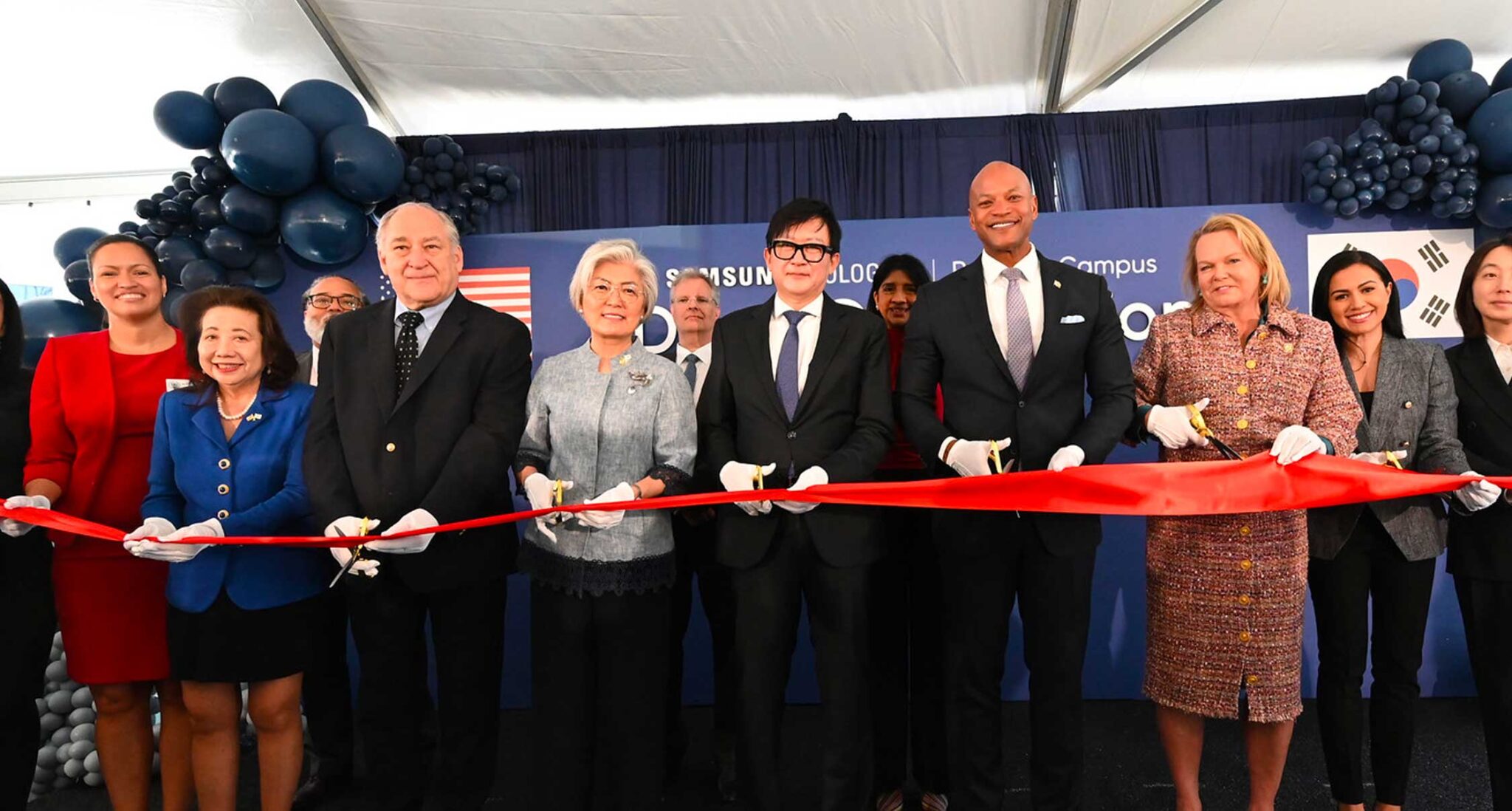
“At Prince George’s Community College, we are committed to empowering our students with the skills and resources needed to thrive in today’s ever-evolving technology landscape,” said college President Dr. Falecia D. Williams at a ribbon-cutting in April. “This initiative provides critical access to cutting-edge cyber ranges that will enhance our ability to train the next generation of cybersecurity professionals.”
Brad Phillips, executive director of the Maryland Association of Community Colleges, called the new cyber ranges “a game-changer.”
“This will place Maryland as the first state in the nation to use range technology for workforce development, which will diversify the workforce and accelerate closing the workforce skills gap,” Phillips said in a statement. “I strongly believe what we are doing should become a model for the nation.”
Early Charm, a venture studio specializing in bringing scientific discoveries to the commercial market, received a $500,000 Build Our Future grant to develop a biomanufacturing incubator with lab space in Harford County.
The CONVERGE Innovation Center supports startup companies and commercializing biomanufacturing technologies developed at Aberdeen Proving Ground (APG), as well as workforce training. Harford Community College began offering data science classes at the facility in the fall of 2024.

With the U.S. Department of Defense putting more than a billion dollars in seed funding for biomanufacturing, Early Charm and its partners saw the need to establish a facility “outside the fence” of APG to draw private companies and investors to capitalize on technology developed “inside the fence” of the base, said Early Charm Executive Officer Ken Malone.
“We’re filling that niche where the high-growth biomanufacturing opportunities are,” Malone said, adding that the sustainability of biomanufacturing – which uses cells and enzymes to create products rather than traditional industrial processes – is a big draw. “Our goal is for more biomanufacturers to eventually locate in Aberdeen.”
The Build Our Future Grant allowed Early Charm to purchase the physical infrastructure and equipment to build out a 500 square-foot pilot manufacturing space – which has the potential to expand to 20,000 square-feet if needed, Malone said.
Early Charm worked closely with Harford County’s Department of Economic Development to bring the project to fruition.
InventWood, a University of Maryland spinout now based in Frederick County, received a $1 million Build Our Future grant to construct a research and pilot manufacturing facility for SUPERWOOD. This next-generation biomaterial has 50% greater strength than steel at roughly one-sixth the weight and delivers up to 10 times the strength-to-weight ratio. It is produced from abundant Maryland forest resources and recycled wood.
The company is now utilizing its new research labs for product development and rigorous material testing, including fire, water, humidity, and UV radiation exposure. This summer, InventWood will launch its first automated production line for SUPERWOOD.
“Traditional construction materials like steel and aluminum generate significant carbon emissions through mining and smelting,” said Dan Nadash, head of government and stakeholder relations at InventWood. “Because trees naturally sequester carbon as they grow, our wood-based materials offer a more sustainable alternative. We’re focused on replacing steel and aluminum in the construction sector.”